Showing posts with label Barrel. Show all posts

Monday, June 13, 2016

Brew #40: "Barrels Don't Have Wheels," April 10, 2016

This title probably needs some explanation. When I first got the barrel I had it on my dining room table.  When I brought my 2 1/2 year old (C) down that morning we had a conversation that went like this:
C: What's that daddy?
Me: Its a barrel
C: Barrels don't have wheels.
Me: That's true
Now any time we see a barrel he reminds me that they don't have wheels (except at mexitaly - mind blown)

On to the beer.  This was case of "what do I put in the barrel next?" I didn't want to put #39 in the barrel for much longer than about 3 weeks so I had to brew the second beer when I racked it into the barrel.  I went round and round and ended up with a chocolate oatmeal stout.  I didn't want to get cocoa powder residue permanently in the barrel so the chocolate is coming from chocolate malt and possible cocoa extract added to the keg.

Recipe
Batch Size Target (Actual): 6 gal (6 gal)
OG Target (Actual): 1.084 (1.082)
FG Target (Actual) : 1.027 (1.018)
Brew House Efficiency Target (Actual) : 69% (67%)
IBUs: 32
Color: 35 SRM
Style: American Stout
Recipe Type: All Grain
Boil Time: 90 minutes

Water:
Carbon filtered York water

Grains:
16 lbs US 2-Row
2 lbs Flaked Oats
1 lb Chocolate Malt
8 oz Carapils
8 oz Caramel 20L
4 oz Roasted Barley
4 oz Black Patent

Hops:
1 oz German Northern Brewer (pellets) @ 90 min.
0.5 oz East Kent Goldings (pellets) @ 25 min.
0.5 oz East Kent Goldings (pellets) @ 5 min.

Yeast:
WLP002 English Ale Yeast

Brewing Notes
4/6/16 - Yeast Starter:
2 Liter yeast starter: 7c of water, 7oz Extra light DME, 1/2 tsp yeast nutrient, boiled 10 minutes and chilled to room temperature, 2 drops of fermcap, pitched WLP002. Fermented on a stir plate.

4/10/16 - Brew Day:
  • Sanitized (star san) my cold side equipment in the big mouth bubbler primary.
  • Heated 25 quarts of water with PH 5.2 to 170 in 8 gallon stainless HLT on outdoor propane burner
  • Mashed in in 10 gal Igloo cooler, paddled until everything was well mixed and there were no dough balls. 60 minute mash rest
    • 0 minutes: temperature was 154F
    • 15 minutes: paddled, temperature was 153F
    • 30 minutes: paddled, temperature was 152-154F
    • 60 minutes, temperature was 152-153F, began vorlauf
  • Manual Vorlauf: I run a 2 cup measuring cup full of wort out of the valve and gently pour this on top of the mash.  Then I repeat until I'm satisfied with the clarity.  This takes about 10-15 minutes.
  • Heated 7+ gallons sparge water with pH 5.2 to 195
  • Ran off and fly sparged until I had 8 1/8 gallons
  • Boil gravity was 15.2% brix - 1.061, right on target.
  • Brought to boil - 90 minute boil time
  • Added:
    1 oz German Northern Brewer (pellets) @ 90 min.
    0.5 oz East Kent Goldings (pellets) @ 25 min.
    0.5 oz East Kent Goldings (pellets) @ 5 min.
  • Chilled to 72 F and siphoned to BMB, Volume was 6 gallons.
  • Took an OG brix reading of 20.1% which calculated to to 1.082.
  • Pitched decanted yeast starter.
4/10 - 4/29/16 - Primary Fermentation:
Transfer to second use balcones whiskey barrel on 4/29 Measured 10.8% brix which calculated to 1.018.  This is quite a bit lower than beersmith predicted.

4/29 - 7/24/16- In Barrel
To prep the barrel this time, after I got #39 out, I gave it a very quick rinse with nearly boiling water 2 or 3 times until the water wasn't cloudy anymore.  I fully expect that if some of the previous belgian yeast wanted to take up residence in this beer, it will.  I wasn't trying to get rid of it. I let this one go for about 3 months.

7/24/16 - Kegged
Kegged on 7/24 to force carb in the kegerator at about 11psi. I measured 11.4% brix which calculated to 1.023, or about 7.8% ABV.  We served a week or so later. Who the heck wants an 8% ABV barrel aged oatmeal stout during the hottest part of the year?

9/23/16 - Bottled
This wasn't getting served frequently enough so the tap was getting stuck closed. We decided to bottle the remaining to make some room in the fridge.  #39 was a little flatter than I'd like in the bottle, so my CO2 pressure in my kegerator got bumped up from 10 to 11 psi.  I was happier with how the beers we carbonated when served on tap, We'll see how that affects the bottled beer.  We bottled 8 22oz bottles and 27 12oz bottles using the "Last Straw" bottle filler.  This time the foam was pretty out of hand, resulting in some low-filled bottles that I don't expect will be as bubbly as I'd like.  About half way through, I shut the CO2 valve to the keg and as the pressure bled off the bottling process was much better.  I think next time we'll try to dial back the pressure at the regulator from the beginning just for bottling, maybe to 3-4 psi.

Tasting
It's big, it's full flavored, it's tasty. It is also improving over time so maybe I'll update this later this winter.  One thing I've noticed is the oak and bourbon flavor in this one is much more mellow than in the beers I've made with soaked chips.


Saturday, May 14, 2016

Brew #39: Big Bad Bourbon Barrel Belgian (quad), March 25, 2016

Quick! You're getting a freshly-dumped 5 gallon Balcones Malt Whiskey barrel as a birthday present. It will be here in a week. What are you going to brew to put in it? Faced with this terrible dilemma, I recalled that Bob, the owner at Bailee's, has a bourbon barrel quad that he makes and occasionally lets out for tasting.  I've never had the opportunity to taste it.  I do know he doesn't use a barrel - its oak chips and bourbon, and I know he uses WLP545 Belgian strong ale yeast with WLP099 super high gravity to finish if necessary.  The rest is a closely-guarded secret.  Nonetheless, I was not interested in duplicating something Bob made, I wanted to make something that was truly my own. So while I can say that his brew put the bug in my brain for a bourbon barrel quad, mine is nothing like his.  I also started searching the internet for what else people have put in these barrels. My favorite was this on one of my favorite homebrew blogs. His was in a "Rumble" barrel, but the concept is similar.  And again, I'm not really content to copy someone's recipe - especially if its something I've never tried.  So here's mine:


Recipe
Batch Size Target (Actual): 6 gal (6 gal)
OG Target (Actual): 1.091 (1.091)
FG Target (Actual) : 1.013 (1.016)
Brew House Efficiency Target (Actual) : 65% (65%)
IBUs: 26
Color: 29 SRM
Style: Belgian Dark Strong Ale
Recipe Type: All Grain
Boil Time: 90 minutes

Water:
Carbon filtered York water

Grains:
14 lbs Belgian Pilsner
5 lbs Vienna
12 oz Caramunich
4 oz Caramel 120L
2 oz Carafa II
1 lb D-180 Candi Syrup @ 10 min boil
1 lb D-90 Candi Syrup @ 10 min boil

Hops:
1/2oz German Hallertau (pellets) @ 90 min.
1/2oz Styrian Goldings (pellets) @ 90 min.
1/2oz Willamette (pellets) @ 90 min.
The seemingly random selection of hops for early additions is because these were leftovers from previous brews.  These are almost solely for bittering so this combination is just to get to the target IBUs with hops that are somewhat true to style.
1/2oz Czech Saaz @ 8 min.
0.1oz Styrian Goldings (pellets) @ 8 min because my brother is a smart ass and couldn't just put 0.6 oz in at the 90 minute addition.

Other:
1 Whrilfloc Tab @ 15 min.

Yeast:
WLP500 Monastery Ale Yeast

Brewing Notes
3/21/16 - Yeast Starter:
2 Liter yeast starter: 8c of water (lost count, should have been 7), 7oz Extra light DME, 1/2 tsp yeast nutrient, boiled 10 minutes and chilled to room temperature. Fermented on a stir plate. As always, WLP500 lags a couple of days before going to work hard.  Cold crashed and decanted the starter overnight from 3/24 into 3/25.  Volume ended up around 600mL
3/25/16 - Yeast Starter stage 2:
First thing in the morning, I boiled and chilled 4 c water, 4 oz extra light DME, and 1/4 tsp yeast nutrient and poured this on top of the yeast cake from stage 1.  Cold crashed and decanted to about 400 mL overnight from 3/25 into 3/26.

3/26/16 - Brew Day:
  • Sanitized (star san) my cold side equipment in the big mouth bubbler primary.
  • Heated 25 quarts of water with PH 5.2 to 169 F in 8 gallon stainless HLT on outdoor propane burner
  • Mashed in in 10 gal Igloo cooler, paddled until everything was well mixed and there were no dough balls. 75ish minute mash rest
    • 0 minutes: temperature was 153F
    • 15 minutes: paddled, temperature was 152-153F
    • 39 minutes: paddled, temperature was 151 F
    • 67 minutes, began vorlauf
  • Manual Vorlauf: I run a 2 cup measuring cup full of wort out of the valve and gently pour this on top of the mash.  Then I repeat until I'm satisfied with the clarity.  This takes about 10-15 minutes.
  • Heated 7 gallons of water with pH 5.2 to 195F
  • Ran off and fly sparged until I had collected 8.12 quarts of wort
  • Boil gravity was 15.3% Brix, 1.061 SG, 2 points over target.
  • Brought to boil - 90 minute boil time
  • Added:
    1/2oz German Hallertau (pellets) @ 90 min.
    1/2oz Styrian Goldings (pellets) @ 90 min.
    1/2oz Willamette (pellets) @ 90 min.
    1 Whrilfloc Tab @ 15 min.
    1/2oz Czech Saaz @ 8 min.
    0.1oz Styrian Goldings (pellets) @ 8 min
  • Chilled  and ran to BMB,
  • Took an OG brix reading of 22.0% which calculated to to 1.091.
  • Pitched yeast starter
3/26-4/9/16 Fermentation:
Here are a couple of pictures, half an hour apart.  I pitched the yeast around 5:00 pm. By 9:00 the krausen was just starting to form. By 9:30 it was 2 inches tall.  Like I've said, WLP500 is a workhorse once it gets started.


4/9-4/29/16 - Barrel:
I will admit, filling this barrel (or planning to fill the barrel) involved far to much agonizing for a homebrewer.  Do I or don't I prep the barrel? Rinse? Sanitize? Wash with Bourbon? Soak?  So I read the forums, I read the barrel basics guide: it said soak for an hour with hot water. I wrote to the Mad Fermentationist: He said no prep. I called my brother (actual brewing professional): He said don't soak unless the barrel is really old and you suspect leaks and don't use too hot of water. Long story short: I soaked it.  I filled the barrel to the brim with 160F water and soaked for 30 minutes.  The water ended up around 140F while in the barrel.  Also it tasted like a hot toddy coming out of the barrel.

So that's what I did. Then I dumped the water and filled (siphon) to the brim with the beer.  I had intended to split the batch into 5 gallons barrel aged and 1 gallon in a little carboy, but the 1 gallon carboy only filled about half way, which wasn't worth keeping to bottle. There was just too much lost to the yeast cake at the bottom.  Beer was 10.8% brix which calculated to 1.014 (10.2% abv). Also it tasted like bananas foster in beer form.

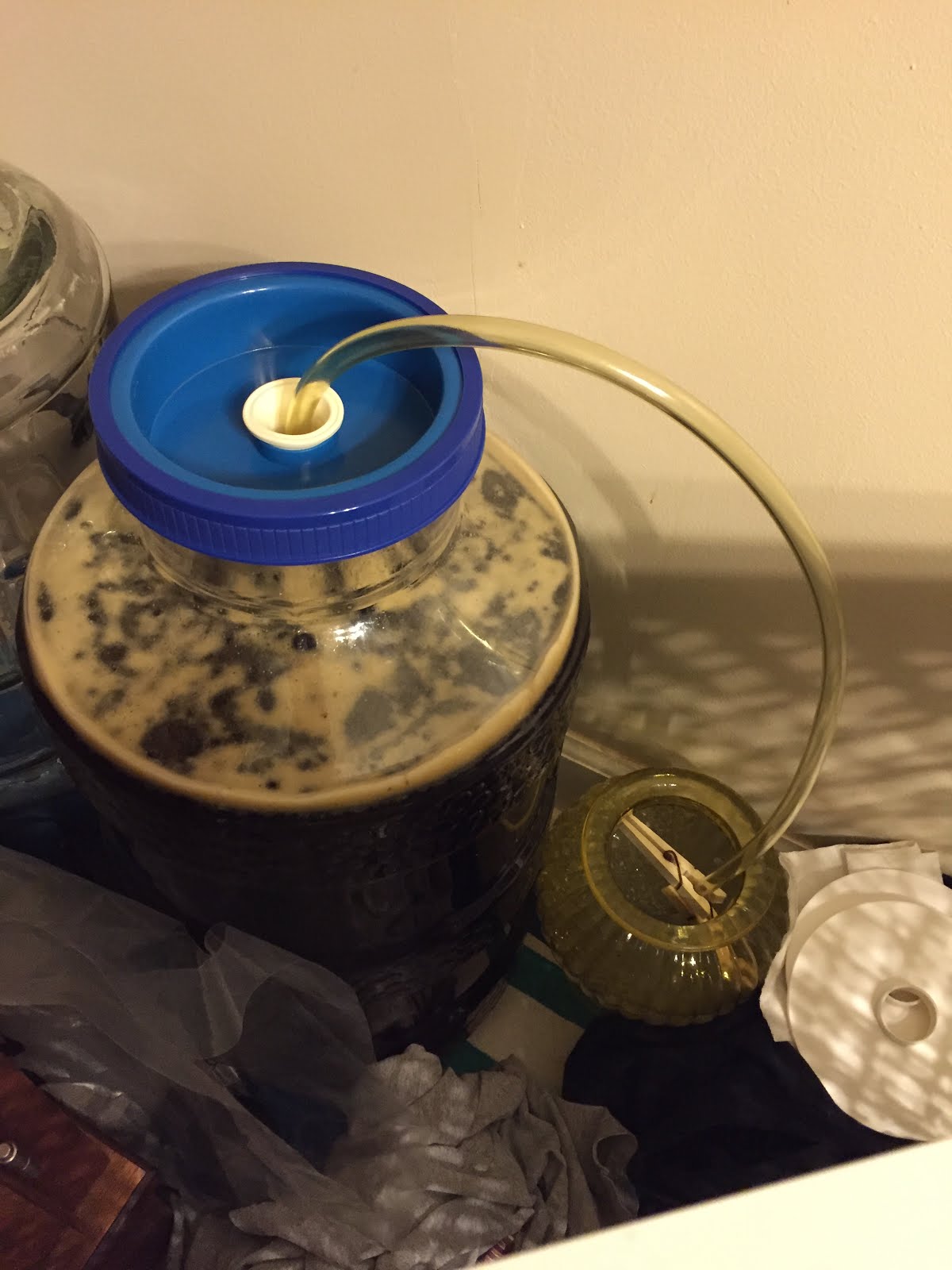
I started to get some foaming through the airlock pretty quickly so I switched to a blowoff tube.  Apparently the wood acts as nucleation sites for the CO2 dissolved in the beer.


4/27 I took a sample from the barrel to taste.  At this point I got less banana, more vanilla and some understated whiskey flavor.  I thought I might give it another 2 weeks.  Then over the next couple of days I decided that I really had liked it and maybe I should go for "well balanced" instead of over the top whiskey flavor. It was about the color and clarity of a good bourbon.


4/29/16 - Kegging:
I know what you're thinking.  I'm not actually going to serve a 10% plus ABV quad on one of my 3 taps.  It's kegged in order to force carb. I'm not willing to risk this beer being over or under carbonated.  I'm going to bottle it and give the bottles a little bit of time to age. At least a week or two... Going into the keg, I got 11.2% Brix, 1.016 FG. Not sure if the barrel soaked up some of the water and alcohol or if something from the barrel brought the gravity up.  Or maybe my refractometer is less accurate than what I give it credit for.


I've already snuck a couple of tastes via a picnic tap.  What's amazed me so far on this beer is how different it has tasted each time. Clearly it is still developing.

5/14/16 - Bottling:
I should have taken some pictures but I was more focused on figuring out the new bottling process.  I bought a Last Straw bottle filler and added a fourth valve to the distributor in my kegerator for the purge line.  I think I'll do a review of the new equipment and process in a separate post, but to make a long story short, this went very well.  Except for 1 or 2 samples, these bottles are doing some conditioning in my basement.