Showing posts with label Extract. Show all posts

Tuesday, April 12, 2016

Brew #23: Honey Amber Ale, May 31, 2015

Here's another kit I bought from Midwest Supplies, which I brewed to the recipe.  I bought this in January or February before I started brewing all grain and it sat in my basement until I had the desire/opportunity to brew it.  This was a bit of a spur-of-the moment, "what am I going to do this weekend" brew.  Because I had the equipment for it now, I brewed this one with a full boil.

Recipe
Batch Size: 5 gal
Boil Size: 5.5 gal
Target OG: 1.054-1.058
Target FG: 1.010-1.016
Style: Amber Ale
Recipe Type: Extract with specialty grains
Boil Time: 60 minutes

Water:
Charcoal filtered York water

Specialty Grains:
8 oz Caramel 80L
2 oz Roasted Barley
2 oz Belgian Special B

Fermentables:
6 lb Gold LME @ 60 min.
2 lb Minnesota clover honey @ 10 min

Hops:
1/2 oz Galena (pellets) @  60 min.
1 oz Fuggles (pellets) @ 2 min.

Other:
1 Whrilfloc Tab @ 15 min.

Yeast:
Wyeast 1056 American Ale

Brewing Notes
5/30/15 - Yeast Starter:
I made a 2 L starter for this one.  I wanted to give this one a little kick start because the yeast was near expiration date. As usual, 8c water, 8oz extra light DME, 1/2 tsp yeast nutrient, boiled 10 minutes and chilled.

5/31/15 - Brew Day:
  • Sanitized (star san) my cold side equipment in the big mouth bubbler primary.
  • Heated 5.5 gal water to 155 F in 8 gallon stainless kettle on my outdoor propane burner.
  • Steeped specialty grains at 155F in muslin bag for 20 minutes.
  • Removed the grain bag and held it above the kettle to drain.
  • Brought to boil
  • Shut off burner.
  • Added all of the LME
  • Returned to boil, set timer for 60 minutes and added:
    1/2 oz Galena (pellets) @  60 min.
    1 Whrilfloc Tab @ 15 min.
    2 lb Minnesota clover honey @ 10 min
    1 oz Fuggles (pellets) @ 2 min.
  • Brought kettle inside and chilled with wort chiller to 74 F
  • Transferred to BMB, then topped off with 1/2 gallon room temperature water to get to 5 Gallons
  • Took an OG reading of 1.060, corrected to 1.062.
  • Pitched entire yeast starter
  • Put the BMB in the beer corner of the dining room with a blow off tube.
5/31/15 - 6/9/15 - Primary Fermentation:
Gravity was 1.008 when I racked to the glass carboy on 6/9.

6/9 - 6/27/15 - Secondary Fermentation

6/27/15 - Bottling:
Bottled with 5oz of clover honey (0.42 cups) boiled in 2 c water to prime.  Gravity was 1.008 (7.1% abv).

??? - First Taste:
Dry and a little Meady.  This one was popular too.

Thursday, April 7, 2016

Brew #18: Lawnmower de Saison, March 28, 2015

A late March snow pushed me back inside, so I brewed #1 of 2 extract kits I bought from Midwest Supplies.  This recipe was exciting to me because it had a fair amount going on: A grain and adjunct bill that looks like a witbier, candi sugar to make it look like a Trappist ale, and a fair amount of hops. I brewed this one with a partial boil on the stovetop.

Recipe
Batch Size: 5 gal
Boil Size: 3 gal
Target OG: 1.055-1.059
Target FG: 1.012-1.016
Style: Saison
Recipe Type: Extract with specialty grains
Boil Time: 60 minutes

Water:
Acadia bottled spring water

Specialty Grains:
0.5 lb Cara20L
0.5 lb Unmalted Wheat

Fermentables:
3.15 lb Wheat LME (65% Wheat, 35% Barley) @ 60 min.
3.15 lb Pilsen LME @ 60 min.
1 lb clear Belgian Candi Sugar @ 15 min.

Hops:
1 oz Saaz (pellets) @  60 min.
1 oz Goldings (pellets) @ 30 min.
1 oz Goldings (pellets) @ 5 min.

Other:
1/4 tsp grains of paradise @ 15 min.
1 oz bitter orange peel @ 15 min.
1/2 oz coriander @ 15 min.
1 Whrilfloc Tab @ 14 min.

Yeast:
Wyeast 3942 Belgian Wheat

Brewing Notes
3/26/15 - Yeast Starter:
This didn't reach my arbitrary 1.060 threshold for making a yeast starter, but I had some question about the health of the yeast.  This was my first time using a Wyeast pack, it had been shipped, and the pack was partially swollen.  Because of this, I made a quick starter, 4C water, 1/4 lb extra light DME, and 1/4 tsp yeast nutrient, boiled 10 minutes and cooled. Then the whole pack of yeast went in the 1L flask.

3/28/15 - Brew Day:
  • Sanitized (star san) my cold side equipment in the big mouth bubbler primary.
  • Heated 3 gal water to 155 F in 5 gallon economy stainless kettle on the stovetop.
  • Steeped specialty grains at 155F in muslin bag for 20 minutes.
  • Removed the grain bag and held it above the kettle to drain.
  • Brought to boil
  • Removed kettle from the burner.
  • Added both types of LME
  • Returned to boil, set timer for 60 minutes and added:
    1oz Saaz @ 60 min.
    1oz Goldings @ 30 min.
    1/4tsp Grains of Paradise @ 15 min.
    1 oz bitter orange peel @ 15 min.
    1/2 oz coriander @ 15 min.
    1 lb clear belgian candi sugar @ 15 min.
    1 tab Whirlfloc @ 14 min.
    wort chiller @ 10 min.
    1 oz Goldings @ 5 min.
  • Moved kettle to the sink and chilled with wort chiller to 100 F
  • Added 2 gal of pre-chilled water to the kettle to bring temperature to 72F
  • Siphoned to BMB, then added more room temperature water until I had 5 Gallons.
  • Took an OG reading of 1.050, corrected to 1.052.  I'm not sure why this one undershot.
  • pitched entire yeast starter
  • Put the BMB in the beer corner of the dining room with a blow off tube.
3/28/15 - 4/1/15 - Primary Fermentation:
Obviously very fast. Gravity was 1.012 when I racked to the glass carboy on 4/1.


4/1 - 4/21/15 - Secondary Fermentation:
Brought down to the basement floor to "cool crash" - it only got down to around 64F

4/21/15 - Bottling:
Bottled  with 4.3oz of corn sugar boiled in 2 c water to prime.  Gravity was 1.008 (5.8% abv). Yield was 50 12 oz bottles.

5/11/15 - First Taste:
A little belgian, a little spicy.  This one was very popular.

Monday, April 4, 2016

Treatise on Extract Brewing

I've caught up to where I had decided to switch to all grain brewing, and before I leave that chapter behind, I wanted to dedicate a post to advice, tricks and tips, etc. on extract brewing.  Once again, I don't consider myself an expert, and I won't be so arrogant  to say that my way is the right way.  But it has worked well for me, so I'm passing it on.

Extract brewing makes good beer
I've made 18 beers using extract and specialty grains, 16 of which were partial boil on my stovetop. I, my family, my friends, and my co-workers have enjoyed every single one of them.  I'll discuss in the next post why I decided to switch to all grain, but I want to go on record saying that it is not necessary to make the switch.  You can make good beer using malt extracts.  There are tremendous options for specialty grains, hops, yeast, and full kits.  As homebrewers, we have better access to varieties of hops than a 10 barrel brewpub. I know this is a bit of a controversial opinion, but I think if a homebrewer wanted to go a lifetime brewing only extract beers, he or she could, and make good beer too.

Brew day basic outline
I've spelled my process out in great detail on a brew-by-brew basis, so this is more of an overview list.

  1. Sanitize all cold side equipment in Star San solution
  2. Heat 3 gallons of water in 5 gallon kettle to 155F
  3. Steep specialty grains in muslin bag for 20-30 minutes
  4. Remove specialty grains and drain the bag.  Do not squeeze, do not rinse.
  5. Bring wort to boil
  6. Remove from heat (take kettle off of burner)
  7. Add malt extracts
  8. Return to boil
  9. Add hops, late malts, and special ingredients per boil schedule
  10. Add flame out, chill the wort in an ice bath or with immersion wort chiller to 100F
  11. Dilute with 2 gallons of 40F water in the kettle
  12. Transfer by siphoning or through a kettle valve into the primary fermenter
  13. Top off to fermenter volume (usually 5 gallons) with room temperature water
  14. Pitch yeast
  15. Close it up and leave it alone for at least a week, maybe 2
  16. Transfer to secondary if necessary
  17. Dry hop directly in secondary if the recipe calls for it
  18. Transfer to bottling bucket and add priming sugar.  Use a calculator.  5 oz is too much. My number is around 4.1 to 4.2 oz these days.  Stir with a sanitized spoon
  19. Bottle and cap
  20. Put the bottles somewhere over 70F ambient
  21. Wait at least 2 weeks
  22. Taste. If it's flat, wait 1-2 more weeks, then try again.
  23. Enjoy

When I help a first timer
Recently, I've had the opportunity to help a couple of friends with their first brews.  Generally they've bought a starter kit and some recipe kit.  I've loaned bits and pieces of equipment to fill in gaps- usually my 5 gallon kettle or a bottle capper or whatever else they need. I really enjoy this hobby and I don't want a first timer to get discouraged because they don't have the right gear.  Then, I come over to their house with a couple of full bottles and help them empty them on brew day.  I try to let them take the lead - most kits have very complete instructions - and I jump in to answer questions or lend a hand as necessary. Ok, I'm sure I give way too much unsolicited advice too.  But to me, this is really about sharing my passion. If I can help someone out with their first brew (and answer questions on subsequent brews), and in doing so, help them find enjoyment in something I enjoy, then I've done what I set out to do.

Random list of tips and tricks
  1. This is #1 on almost anyone's list. Sanitize.  Don't cheat at this.  Everything that is going to touch the wort or beer after the boil needs to be sanitized.  I use Star San because it has worked for me.  I haven't had any infections.  I can't complain about those results
  2. Clean up quickly.  After the boil, clean the kettle and everything else you used ASAP. The remnants of the wort turn into some kind of impenetrable glue, so the longer you wait, the harder it will be to clean. The same goes for a primary after transferring, secondary and bottling equipment after bottling and bottles after drinking.  I clean all of those using oxy clean free.  Again, it has worked for me so far, so I see no reason to change. If fermenting vessel is really gummed up, soaking helps.
  3. Make sure you have plenty of ice if you chill in an ice bath.  I started to buy a 20 lb bag of ice for each brew when I bought my bottled water, and when I chilled I melted all of this ice, plus most of my ice maker's ice.
  4. Using a nylon hop bag: probably not.  I think this one is really up to the brewer, but I'm not doing it any more.  I generally used one for beers that were not dry hopped and didn't bother on dry hopped beers since I was going to put dry hops directly in the secondary.   I use a sanitized bag on the discharge end of the the transfer hose when I transfer a dry hopped beer to the bottling bucket or keg to keep most of the hops out of the glass.
  5. If you are going to use a nylon hop bag in the boil, I got a nice tip at Bailee's on how to clean it:  After draining the liquid from the bag, fold it up in some aluminum foil and put that in the freezer.  The next morning (or in my case, the next brew day, pull that out and you can pull the whole mess out as a big hopsicle without burning your hands.  Then rinse and boil the bag to get the staining out.
  6. Chilling strategy: Lapsing into engineering for a moment- the conductive heat transfer rate is proportional to the square of the temperature difference.  This means you're going to get much faster chilling if you keep this difference as large as possible.  Ice water is 32F and you can't really change that.  But, if you use the ice bath to chill 3 ish gallons to 100F, then dilute with chilled water, this will be much faster than if you add the chilled water first and try to chill 5 gallons all the way down to 70.  Convective heat transfer is faster if the fluids are moving, so it pays to keep stirring the wort and the ice bath.  Nerdy enough?
What I should have done differently
  1. Bought a water filter.  I never wanted to brew with my tap water because it is chlorinated. Chlorine is added to municipal water systems to kill micro-organisms.  This doesn't sound like something that yeast would like. Instead, I bought 6-8 gallons of bottled spring water from the grocery store for each brew.  Let's call that 7 average times 16 brews = 112 gallons of bottled water.  At about $1 apiece, I'm out $112 for water, not to mention I recycled 112 1-gallon bottles. When I switched to all grain, I bought a $35 under sink carbon filter.  I definitely should have done that sooner.
  2. Electric stoves don't regulate heat very well.  You have to pick up the kettle to avoid a boil over, move the kettle off the burner to add malt extracts, etc.  If your budget allows it, a propane or natural gas burner is way easier.

Sunday, April 3, 2016

Brew #16: Town Hall Hope & King Scotch Ale, February 1, 2015

This was an extract kit from Northern Brewer with yeast from Bailee's.  Call this another entry in the "clones of things I've never tried the original of" category.

Recipe
Batch Size: 5 gal
Boil Size: 3 gal
Target OG: 1.060
Target FG: ???
Style: Scotch Ale
Recipe Type: Extract with specialty grains
Boil Time: 60 minutes

Water:
Acadia bottled spring water

Specialty Grains:
0.25 lb Caramel 20
0.25 lb English Chocolate Malt
0.25 lb English Medium Crystal
0.125 lb English Roasted Barley
0.1875 lbs (that's 3 oz for a non-engineer) Belgian Special B

Fermentables:
6 lbs Gold LME @ 60 Min
2 lbs Light DME @ 15 Min

Hops:
0.25 oz Centennial (pellets) @ 60 min.
3 oz Fuggles (pellets) @ 10 min.

Other:
1 Whrilfloc Tab @ 12 min.

Yeast:
White Labs WLP028 Edinburgh Ale Yeast

Brewing Notes
1/29/15 - Yeast Starter:
This one just barely met my 1.060 threshold to make a starter. This was my no calculator 1 Liter yeast starter: 4c of water, 1/4 lb Extra light DME, 1/4 tsp yeast nutrient, boiled 10 minutes and chilled to 72F

2/1/15 - Brew Day:
  • Sanitized (star san) my cold side equipment in the big mouth bubbler primary.
  • Heated 3 gal water to 130 F in 5 gallon economy stainless kettle on the stovetop.
  • Steeped specialty grains starting at 130F in muslin bag for until temperature reached 155F, then held for 20 minutes.
  • Continued the steep as I raised the temperature to 170F
  • Removed the grain bag and held it above the kettle to drain.
  • Brought to boil
  • Removed kettle from the burner.
  • Added 6 lbs Gold LME and stirred well
  • Returned to boil, set timer for 60 minutes and added:
    0.25oz Centennial @ 60 min.
    2 lbs light DME @ 15 minutes (off of burner, paused timer until re-boil)
    1 tab Whirlfloc @ 12 minutes
    3oz Fuggles and wort chiller @ 10 minutes
    All hops were in a nylon mesh bag.
  • Moved kettle to the sink and chilled with wort chiller to 100 F
  • Added 2 gal of pre-chilled water to the kettle to bring temperature to 72F
  • Siphoned to BMB, then added more room temperature water and the entire yeast starter until I had 5 Gallons.
  • Took an OG reading of 1.060, corrected to 1.062.
  • Put the BMB in the beer corner of the dining room with a blow off tube.
1/29 - 2/15/2015 - Primary Fermentation:
Nothing of note. Gravity was 1.016 when I racked to the glass carboy on 2/15.

2/15-3/17/2015 - Secondary Fermentation:
I actually waited the recommended 4 weeks.  My method for patience was working.

3/17/2015 - Bottling:
Bottled  with 5oz of corn sugar boiled in 2 c water to prime.  Gravity was 1.014 @ 70F, corrected to 1.016 (6.0 abv). Yield was 44 12 oz bottles and 4 16 oz swing-tops.

??? - First Taste:
no notes, no date (a theme?)

4/3/2016 - Update:
I actually have a couple of these in my basement still.  You could call it a cellar if you wanted.  The fact that it has lasted this long without me intending to age any is a bit of an indication of its lack of popularity.  I'm not saying it is bad by any means.  It has a very nice malt-forward taste and is relatively full-bodied.  However, most of my friends and family just don't prefer this style.

Brew #15: Plinian Legacy 2, January 17, 2015

Remember when I tasted Brew #10 on Christmas Eve and immediately decided to brew it again? Well I wasn't kidding.  I logged on to my computer and bought the kit right then and there. What I didn't realize was that sometime between when I bought the 2 kits, there was a Simcoe shortage, so Northern Brewer substituted "Simply Select Hop Blend" for the 5 oz of Simcoe that was in the first kit. Unfortunately, I don't think the piney character of Simcoe can be replicated, so this version was not as good as the first.  Plus, I think I got a little tired of it.  I don't usually have 4 cases in a row of the same beer.

Recipe
Batch Size: 6 gal
Boil Size: 3 gal
Target OG: 1.070
Target FG: ???
Style: IIPA
Recipe Type: Extract with specialty grains
Boil Time: 90 minutes

Water:
Acadia bottled spring water

Specialty Grains:
10 oz Carapils
6 oz Bairds Carastan

Fermentables:
4 lbs Pilsen DME @ 90 min.
6 lbs Pilsen LME @ 15 min.
0.75 lb corn sugar @ 0 min.

Hops:
0.25 oz Amarillo (pellets) @ steeping grains (FWH)
10 mL (2x) Hopshot @ 90 min
1 oz Columbus (pellets) @ 45 min
1 oz Simply Select Hop Blend (pellets) @ 20 min
1.5 oz Centennial (pellets) @ 0 min, steep 10 min.
2.5 oz Simply Select Hop Blend (pellets) @ 0 min, steep 10 min.
1.5 oz Columbus (pellets) Dry Hop in secondary 15 days
1 oz Centennial (pellets) Dry Hop in secondary 15 days
1 oz Simply Select Hop Blend (pellets) Dry Hop in secondary 15 days
0.5 oz Columbus (pellets) Dry Hop in secondary 5 days
0.5 oz Simply Select Hop Blend (pellets) Dry Hop in secondary 5 days
0.25 oz Centennial (pellets) Dry Hop in secondary 5 days
0.25 oz Amarillo (pellets) Dry Hop in secondary 5 days

Other:
1 Whirlfloc Tab @ 10 min.

Yeast:
White Labs WLP001

Brewing Notes
1/14/15 - Yeast Starter:
I made my standard yeast starter with 4c water, 4 oz extra light DME, and 1/4 tsp yeast nutrient, boiled for 10 minutes and chilled to around 80F.  Then, as usual, I shook like crazy until it was aerated and pitched the yeast.

1/17/14 - Brew Day:
  • Sanitized (star san) my cold side equipment in the big mouth bubbler primary.
  • Heated 3 gal water to 155-160 F in 5 gallon economy stainless kettle on the stovetop.
  • Steeped specialty grains in muslin bag for 20 minutes.  At the same time added .25 oz Amarillo hops directly in the kettle.
  • Removed the grain bag and held it above the kettle to drain.
  • Brought to boil
  • Removed kettle from the burner.
  • Added 4lbs pilsen LT DME and stirred well
  • Set timer for 90 minutes and added:
    10mL Hopshot @ 90 min.
    1oz Columbus @ 45 min.
    1oz Simply Select @ 20 min.
    6lb Pilsen LME @ 15 min.
    1 Whirlfloc tab and wort chiller @ 10 min.
    0.75 lb corn sugar, 1.5 oz Centennial, 2.5 oz Simply Select @ 0 min.
  • Removed the kettle from heat and allowed to stand for 20 minutes
  • Moved kettle to the sink, hooked up my wort chiller and ran cold water to chill to 100 F
  • Added 2 gal of pre-chilled water to the kettle to bring temperature to 70F
  • Siphoned to BMB, then added more room temperature water and the entire yeast starter until I had 6 Gallons.
  • Took an OG reading, corrected to 1.077. Extracts are very consistent.
  • Put the BMB in the beer corner of the dining room with a blowoff tube.
1/17 - 1/26/2014 - Primary Fermentation:
Nothing of note in the primary, but I'm sure this one blew off through the tube.  Racked to 5 gal glass carboy on 1/26 and measured gravity of 1.016.

1/26-2/20/2014 - Secondary Fermentation:
Dry hops:  On 2/7 added:
1.5 oz Columbus (pellets)
1 oz Centennial (pellets)
1 oz Simply Select (pellets)
on 2/15 added:
0.5 oz Columbus (pellets)
0.5 oz Simply Select (pellets)
0.5 oz Centennial (pellets)
0.25 oz Amarillo (pellets)
All of these were directly to the carboy. Here it is just before bottling:


2/20/2014 - Bottling:
Bottled with 5oz of corn sugar boiled in 2 c water to prime. Gravity was 1.018 after the priming sugar was added, so I used the 1.016 from racking to the secondary for FG.

??? - First Taste:
No date, no notes.  This was not quite the same as the first because of the change from Simcoe to Simply Select.  I still had no shortage of volunteers to drink them.

Brew #14: Conundrum Session IPA (modified), December 28, 2014

This was another time when I browsed Northern Brewer's recipe and then went to Bailee's for the ingredients. I didn't want to wait for shipping so I could brew once more during my Christmas Break.  At the time, Northern Brewer was substituting "Simply Select" hops for Simcoe in their kits due to a shortage of Simcoe.  I didn't know what Simply Select was and neither did any of the staff at Bailee's, so we ended up choosing Citra. So I made a nearly completely different session IPA than what intended by Northern Brewer's kit.  The recipe that follows is as I brewed it.

Lauren (my wife) bought me a copper immersion wort chiller for Christmas, so this was an addition to my process for this brew.  My kitchen sink faucet is a pull-down sprayer type, so there was no way I could adapt the faucet to the chiller. Instead, I added a little bit of "special" plumbing in the cabinet under my sink.  This valve and barb fitting comes off of a T in the cold water line under my sink, after the shut-off valve and before the faucet.  I use the hose adapter that came with the chiller on the discharge end to act as a weight to keep the tubing from spraying hot water all over the place.


Recipe
Batch Size: 5 gal
Boil Size: 3 gal
Target OG: 1.045
Target FG: ???
Style: Session IPA
Recipe Type: Extract with specialty grains
Boil Time: 60 minutes

Water:
Acadia bottled spring water

Specialty Grains:
1 lb Caramel 20L

Fermentables:
3.3 lbs Pilsen Light LME @ 60 min.
3.3 lbs Pilsen Light LME @ 15 min.

Hops:
0.5 oz Amarillo (pellets) During steep (FWH)
0.5 oz Centennial (pellets) @ 60 min.
0.5 oz Amarillo (pellets) @ 20 min.
0.5 oz Citra (pellets) @ 20 min.
0.5 oz Amarillo (pellets) @ 5 min.
0.5 oz Crystal (pellets) @ 5 min.
0.5 oz Centennial (pellets) dry hop 7 days
0.5 oz Amarillo (pellets) dry hop 7 days
0.5 oz Citra (pellets) dry hop 7 days
0.5 oz Crystal (pellets) dry hop 7 days


Other:
1 Whrilfloc Tab @ 10 min.

Yeast:
Safale US-05 pitched dry

Brewing Notes
12/28/14 - Brew Day:
  • Sanitized (star san) my cold side equipment in the big mouth bubbler primary.
  • Heated 3 gal water to 150-155 F in 5 gallon economy stainless kettle on the stovetop.
  • Steeped specialty grains in muslin bag for 20 minutes. At this time, I also added 0.5 oz Amarillo pellets directly to the kettle.
  • Removed the grain bag and held it above the kettle to drain.
  • Brought to boil
  • Removed kettle from the burner.
  • Added 3.3lbs Pilsen Light LME and stirred well
  • Returned to boil, set timer for 60 minutes and added:
    0.5 oz Centennial (pellets) @ 60 min.
    0.5 oz Amarillo (pellets) @ 20 min.
    0.5 oz Citra (pellets) @ 20 min.
    3.3 lbs Pilsen Light LME @ 15 min.
    Wort Chiller & Whirlfloc @ 10 min.
    0.5 oz Amarillo (pellets) @ 5 min.
    0.5 oz Crystal (pellets) @ 5 min.
    All hops were loose in the kettle.
  • Moved kettle to the sink and hooked up the wort chiller to my new plumbing, running cold water until wort temp reached 100 F, which was lightening fast compared to the ice bath method
  • Added 2 gal of pre-chilled water to the kettle to bring temperature to 72F
  • Siphoned to BMB, then added more room temperature water and the entire yeast starter until I had 5 Gallons.
  • Took an OG reading of 1.046, corrected to 1.048.
  • Sprinkled the yeast dry directly on top of the wort.
  • Put the BMB in the beer corner of the dining room.
12/28/2014 - 1/5/2015 - Primary Fermentation:
I siphoned to my second 5 gallon glass carboy that had just been emptied/cleaned/sanitized after Brew #12.  Gravity was 1.014.

1/5-1/20/2015 - Secondary Fermentation:
Dry hopped on 1/13 with a half-ounce each of Crystal, Citra, Amarillo, Centennial all added directly to the secondary.

1/20/2015 - Bottling:
Bottled per our standard practice with 5oz of corn sugar boiled in 2 c water to prime.  Gravity was 1.012 @ 68F, corrected to 1.013 (4.6% abv). Yield was 44 12 oz bottles.

??? - First Taste:
No date, no notes.  This was a favorite with my family and drank pretty quickly.  I repeated an all grain version of this for Brew #25 but didn't have a chance to do a side-by-side.  It wouldn't have been fair anyway because the hop character would have faded severely.

Brew #13: Belgian Dubbel, December 21, 2014

This was a another straight-up extract kit from Northern Brewer.  I will say up front, we really liked this one.  I once again bought the kit without yeast since I could get it at the local homebrew store. To me, this is just a reasonable reduction in risk.  The local shop gets a shipment of yeast every Thursday, bulk packaged and kept cool.  I can't say that UPS delivery of a single or 2 vials would be so predictable.

Recipe
Batch Size: 5 gal
Boil Size: 3 gal
Target OG: 1.062
Target FG: ???
Style: Belgian Dubbel
Recipe Type: Extract with specialty grains
Boil Time: 60 minutes

Water:
Acadia bottled spring water

Specialty Grains:
0.25 lb Belgian Cara 45
0.25 lb Belgian Special B

Fermentables:
6.3 lbs  Gold LME @ 60 min.
1 lb Light DME @ 60 min.
1 lb Dark Belgian Candi Sugar @ 15 min.

Hops:
1 oz Tradition (pellets) @ 60 min.
1 oz Hersbrucker (pellets) @ 10 min.

Other:
1 Whrilfloc Tab @ 14 min.

Yeast:
White Labs WLP 500 Trappist Ale Yeast (they call this Monastery Ale Yeast now)

Brewing Notes
12/18/14 - Yeast Starter:
I made a yeast starter for this kit because of the 1.062 anticipated starting gravity.  The staff at Bailee's also advised me that the WLP500 is a workhorse but a slow starter.  So the yeast starter was a good way to cut down on the lag time.  True to form, it took 36+ hours before I started seeing any activity in the starter. 4c Water, 4 oz extra light DME, 1/4 tsp yeast nutrient, boiled together for 10 minutes, chilled to 82F and shaken up in the 1 liter Erlenmeyer flask.  Volume with the yeast in there was around 800ml.

12/21/14 - Brew Day:
  • Sanitized (star san) my cold side equipment in the big mouth bubbler primary.
  • Heated 3 gal water to 150-155 F in 5 gallon economy stainless kettle on the stovetop.
  • Steeped specialty grains in muslin bag for 20 minutes.
  • Removed the grain bag and held it above the kettle to drain.
  • Brought to boil
  • Removed kettle from the burner.
  • Added 6.3lbs Gold LME and 1 lb light DME and stirred well
  • Returned to boil, set timer for 60 minutes and added:
    1oz German Tradition @ 60 min.
    1 lb dark Belgian Candi Sugar @ 15 min.
    1 whirlfloc tab @ 14 min.
    1 oz Hersbrucker @ 10 min.
    All hops were in a nylon mesh bag.
  • Moved kettle to the ice bath in the sink to chill to 100 F
  • Added 2 gal of pre-chilled water to the kettle to bring temperature to 68/70F
  • Siphoned to BMB, then added more room temperature water and the entire yeast starter until I had 5 Gallons.
  • Took an OG reading of 1.062, corrected to 1.064.
  • Put the BMB in the beer corner of the dining room.
12/21 - 12/28/2014 - Primary Fermentation:
Active fermentation began quickly due to the yeast starter, and appeared to be complete in 7 days.  Here's a video from day 2:


I siphoned to the 5 gallon glass carboy on 12/28 and did not sample or test gravity.

12/28/2014-1/28/2015 - Secondary Fermentation:
I let this one sit for exactly 1 month, giving it a little time to bulk condition and clarify.  Based on the timing, I had added my second secondary to my collection.

1/28/2015 - Bottling:
Bottled per our standard practice with 5oz of corn sugar boiled in 2 c water to prime.  Gravity was 1.006 @ 72F, corrected to 1.008 (7.4 abv). Yield was 51 12 oz bottles.

2/6/15 - Cheater Taste:
I don't know why I snuck this taste after 1 week, but it wasn't carbonated.

2/15/2015 - First Taste:
Fully carbonated at this time.  I noted tastes of banana, toast, and a little mellow alcohol heat.  This beer was very good.  One of my friends says it was the best I've brewed.  I also had the opportunity to do a blind taste test with this compared to the all-grain version (Brew #22).  My family and I agreed we couldn't pick out which one was extract and which one was all grain (we actually all picked wrong).  And we all thought the extract version was better.  Now I think there were some extenuating cirumstances: I messed up the AG version by oxidizing it pretty bad, and the extract version had been aging for at least 4 months longer at the time, while the AG was still pretty green.

Saturday, April 2, 2016

Brew #12: Bailee's Winter Warmer, December 7, 2014

This was an impulse buy.  I went to Bailee's for yeast and I left with this house brand winter warmer kit too.

Recipe
Batch Size: 5 gal
Boil Size: 3 gal
Target OG: 1.060-1.065
Target FG: 1.014-1.018
Style: Specialty/Spiced Beer
Recipe Type: Extract with specialty grains
Boil Time: 60 minutes

Water:
Acadia bottled spring water

Specialty Grains:
??? Only Bob and Bailee know.  And one of them is a dog.

Fermentables:
3.3 lbs light LME
3.3 lbs amber LME.
1 lb amber DME
1 lb corn sugar

Hops:
1 oz East Kent Goldings (pellets) @ 60 min.
1 oz Fuggles (pellets) @ 10 min.

Other:
Mystery spice pack (appears to be orange peel, cinnamon, nutmeg) @ 15 min.
1 whirlfloc tab @ 15 min.
2 whole vanilla beans in secondary for 1 week before bottling

Yeast:
2 packs Danstar Nottingham dry yeast

Brewing Notes
12/7/14 - Brew Day:
  • Sanitized (star san) my cold side equipment in the big mouth bubbler primary.
  • Heated 3 gal water to 110 F in 5 gallon economy stainless kettle on the stovetop.
  • Steeped specialty grains in muslin bag as the temperature rose to 155F, then held at 155 for 20 more minutes.
  • Removed the grain bag and held it above the kettle to drain.
  • Brought to boil
  • Removed kettle from the burner.
  • Added all fermentables and stirred well
  • Returned to boil, set timer for 60 minutes and added:
    1oz Goldings @ 60 min.
    Spice pack @ 15 min.
    Whirlfloc @ 15 min.
    1oz Fuggles @ 10 min.
    All hops were in a nylon mesh bag.
  • Moved kettle to the ice bath in the sink to chilled to 100 F
  • Added 2 gal of pre-chilled water to the kettle to bring temperature to 72F
  • Siphoned to BMB, then added more room temperature water until I had 5 Gallons.
  • Took an OG reading of 1.062, corrected to 1.064.
  • During chilling, I re-hydrated both packs of yeast in about 8 oz of 85 degree water.  This was in a 2 cup measuring cup, which was needed because it nearly foamed over.
  • Put the BMB in the beer corner of the dining room.
12/7 - 12/16/2014 - Primary Fermentation:
Nothing of note during primary.  Racked to 5 gal glass carboy on 12/16.  Gravity was 1.014

12/16-12/23/2014 - Secondary Fermentation:
Conditioned for 1 week on the 2 vanilla beans.

12/23/2014 - Bottling:
Bottled per our standard practice with 5oz of corn sugar boiled in 2 c water to prime. FG was 1.014 (6.6% abv)

??? - First Taste:
No date or notes.  I know these drank quickly and easily last winter.

Brew #11: Bourbon Barrel Porter, November 22, 2014

Brew #11 and I finally got around to brewing an bourbon/oaked beer.  This was on my to-brew list from the start.  I bought this kit from Northern Brewer at the same time as the Plinian Legacy to save on shipping.  Since I could get the yeast locally, I didn't risk it getting screwed up in shipping.

Recipe
Batch Size: 5 gal
Boil Size: 3 gal
Target OG: 1.065
Target FG: ???
Style: Porter
Recipe Type: Extract with specialty grains
Boil Time: 60 minutes

Water:
Acadia bottled spring water

Specialty Grains:
1 lb English Chocolate Malt
0.5 lb English Dark Crystal
0.5 lbs English Black Malt

Fermentables:
2 lbs Wheat DME @ 60 min.
6.3 lbs Dark LME @ 15 min.

Hops:
1 oz Chinook (pellets) @ 60 min.
0.5 oz US Goldings (pellets) @ 15 min.
0.5 oz US Goldings (pellets) @ 5 min.

Other:
2 oz Medium toast oak cubes, secondary 12 days
16 fl oz Makers Mark Bourbon, secondary 12 days

Yeast:
White Labs WLP 028 Edinburgh Scottish ale yeast

Brewing Notes
11/19/14 - Yeast Starter:
Again, the kit's recipe recommended a yeast starter due to the high starting gravity, so 3 days prior to brewing I made a 4 cup starter: boiled 4 cups of water, 4 oz extra light DME, and 1/4 tsp yeast nutrient for 10 minutes.  I chilled to 82F in an ice bath, then poured into the 1 liter flask, shook it up like crazy, then poured in the vial of yeast

11/22/14 - Brew Day:
  • Sanitized (star san) my cold side equipment in the big mouth bubbler primary.
  • Heated 3 gal water to 155 F in 5 gallon economy stainless kettle on the stovetop.
  • Steeped specialty grains in muslin bag for 20 minutes.
  • Removed the grain bag and held it above the kettle to drain.
  • Brought to boil
  • Removed kettle from the burner.
  • Added 2lbs Wheat DME and stirred well
  • Returned to boil, set timer for 60 minutes and added:
    1oz Chinook @ 60 min.
    1/2 oz Goldings @ 15 min.
    6.3 lbs Dark LME @ 15 min.
    1/2 oz Goldings @ 5 min.
    All hops were in a nylon mesh bag.
  • Moved kettle to the ice bath in the sink to chill to 100 F
  • Added 2 gal of pre-chilled water to the kettle to bring temperature to 70F
  • Siphoned to BMB, then added more room temperature water and the entire yeast starter until I had 5 Gallons.
  • Took an OG reading of 1.064, corrected to 1.066
  • Put the BMB in the beer corner of the dining room.
11/22 - 12/6/2014 - Primary Fermentation:
Active fermentation began within 8 hours.  I like yeast starters.  They go well with my impatience.  Rather than waiting out up to 3 days lag time, I get to see near-instant results.  Starting at this point, I planned to make a starter for any beer with OG of 1.060 or greater. Racked to secondary on 12/6 - Gravity was 1.024 (5.5% ABV)

12/6-12/30/2014 - Secondary Fermentation:
Bulk conditioning and bourbon/oak aging.  On 12/16 I started soaking the 2 oz of oak cubes in 16 oz bourbon in a quart mason jar.  On 12/18 I took an FG measurement on the beer, which was still 1.024 (5.5% abv).  I did this here because after adding the bourbon, these measurements would be meaningless.  I poured the oak cubes and all of the bourbon into the secondary on 12/18.  I did some math to figure the approximate final abv of the beer based on the addition of 16 oz of 50% alcohol.  My estimate is 6.4% abv.

12/30/2014 - Bottling:
Bottled per our standard practice with 5oz of corn sugar boiled in 2 c water to prime. I didn't bother taking an FG reading because of the reasons discussed above. Yield was 52 12 oz bottles.

1/15/2015 - First Taste:
Fully carbonated at this time, but I rationed these, assuming it would improve over time and it did. By the time I tasted the last one in November, I think this had reached it's prime.  Too bad it was gone... I guess I needed to repeat this one too.  See Brew #28.

Brew #10: Plinian Legacy, November 15, 2014

Brew #10 was my first in a line of "clones of things I've never tried the original of."  This is Northern Brewer's version of Russian River's Pliny the Elder. I bought the Plinian Legacy extract kit online from Northern Brewer without yeast or priming sugar.  I bought a vial of WLP001 from Bailee's a few days before brew day as well as a one liter Erlenmeyer flask and some extra light DME.  The kit's instructions strongly recommended a yeast starter due to the size of this beer, so I decided this would be a good first time to do that.

Recipe
Batch Size: 6 gal
Boil Size: 3 gal
Target OG: 1.070
Target FG: ???
Style: IIPA
Recipe Type: Extract with specialty grains
Boil Time: 90 minutes

Water:
Acadia bottled spring water

Specialty Grains:
10 oz Carapils
6 oz Bairds Carastan

Fermentables:
4 lbs Pilsen DME @ 90 min.
6 lbs Pilsen LME @ 15 min.
0.75 lb corn sugar @ 0 min.

Hops (brace yourself):
0.25 oz Amarillo (pellets) @ steeping grains (FWH)
10 mL (2x) Hopshot @ 90 min
1 oz Columbus (pellets) @ 45 min
1 oz Simcoe (pellets) @ 20 min
1.5 oz Centennial (pellets) @ 0 min, steep 10 min.
2.5 oz Simcoe (pellets) @ 0 min, steep 10 min.
1.5 oz Columbus (pellets) Dry Hop in secondary 15 days
1 oz Centennial (pellets) Dry Hop in secondary 15 days
1 oz Simcoe (pellets) Dry Hop in secondary 15 days
0.5 oz Columbus (pellets) Dry Hop in secondary 5 days
0.5 oz Simcoe (pellets) Dry Hop in secondary 5 days
0.25 oz Centennial (pellets) Dry Hop in secondary 5 days
0.25 oz Amarillo (pellets) Dry Hop in secondary 5 days

Other:
1 Whirlfloc Tab @ 10 min.

Yeast:
White Labs WLP001

Brewing Notes
11/12/14 - Yeast Starter:

This was a new part of my process starting on this brew. The kit's recipe recommended a yeast starter due to the high starting gravity, so I bought a one liter Erlenmeyer flask, an appropriate drilled stopper, an additional airlock, and some extra light DME from Bailee's to get a starter started.  I did not use any kind of yeast calculator.  This was mostly a "wing it" based on advice I got from the staff at Bailee's.  I boiled 4c bottled water, with 4 oz of extra light DME in a small pot on the stovetop for 10 minutes, then chilled in an ice bath and poured it into the sanitized Erlenmeyer flask.  I covered this with sanitized aluminum foil and my hand and shook vigorously for 30 seconds to aerate. Then I poured all of the yeast into the flask.  Due do boil-off, the volume was around 650mL.  Here's the starter on 11/14 and 11/15:


11/15/14 - Brew Day:
  • Sanitized (star san) my cold side equipment in the big mouth bubbler primary.
  • Heated 3 gal water to 155 F in 5 gallon economy stainless kettle on the stovetop.
  • Steeped specialty grains in muslin bag for 20 minutes.  At the same time added .25 oz Amarillo hops directly in the kettle.
  • Removed the grain bag and held it above the kettle to drain.
  • Brought to boil
  • Removed kettle from the burner.
  • Added 4lbs pilsen LT DME and stirred well
  • Set timer for 90 minutes and added:
    10mL Hopshot @ 90 min.
    1oz Columbus @ 45 min.
    1oz Simcoe @ 20 min.
    6lb Pilsen LME @ 15 min.
    1 Whirlfloc tab @ 10 min.
    0.75 lb corn sugar, 1.5 oz Centennial, 2.5 oz Simcoe @ 0 min.
  • Removed the kettle from heat and allowed to stand for 10 minutes
  • Moved kettle to the ice bath in the sink to chill to 100 F
  • Added 2 gal of pre-chilled water to the kettle to bring temperature to 76F
  • Siphoned to BMB, then added more room temperature water and the entire yeast starter until I had 6 Gallons. The 6 Gal volume is due to the large expected fermentation losses.
  • Took an OG reading of 1.074, corrected to 1.077
  • Put the BMB in the beer corner of the dining room with a 1.5 inch blowoff tube.  I wanted to be ready since there was almost no head space left in the fermenter.
11/15 - 11/22/2014 - Primary Fermentation:
Active Fermentation began almost immediately, blowing off through the 1.25 inch blowoff tube in 6 hours.  I also covered the carboy in an old t-shirt to keep the hop oils from getting lightstruck.  This is Where I noticed that the BMB leaked a little bit around the ring because I started to get some sticky hoppy staining on the t-shirt.

11/22-12/14/2014 - Secondary Fermentation:
All about dry hops.  On 11/29 added:
1.5 oz Columbus (pellets)
1 oz Centennial (pellets)
1 oz Simcoe (pellets)
on 12/9 added:
0.5 oz Columbus (pellets)
0.5 oz Simcoe (pellets)
0.25 oz Centennial (pellets)
0.25 oz Amarillo (pellets)
All of these were directly to the carboy.

12/14/2014 - Bottling:
Bottled per our standard practice with 5oz of corn sugar boiled in 2 c water to prime. Gravity was 1.014, which I calculated to mean 8.3% abv.  Yield was 46 12 oz bottles.  I certainly put a sanitized nylon mesh bag over the end of the siphon hose to keep most of the hops out of the bottling bucket.

12/24/2014 - First Taste:
It was Christmas eve and my brothers were over... So we decided to try 1. or maybe 6.  Carbonation was good, and on a hop bomb like this, I'd prefer to enjoy it fresh.  I decided right away to brew this again so I could have more when the first batch kicked.  See Brew #15.

12/25/2014 - Photo OP:
My brother-in-law and his girlfriend got me these custom glasses for Christmas.  Here's the Plinian Legacy in the glasses.

Brew #9: Mocha Stout, October 19, 2014

Brew #9 was based on an extract kit from Bailee's Homebrew, house brand.  I had it in my mind that I wanted to make a java stout and for simplicity and budgetary reasons I decided to start with an existing extract kit and doctor it, rather than build a recipe from the ground up.  I was very happy with this one, but it still provided a few "learning opportunities" which I'll spell out as they come up in this post.  Additions to the base recipe included some English roasted barley, and extra pound of DME, cocoa powder, and a quart of espresso.

Recipe
Batch Size: 5 gal
Boil Size: 3 gal
Target OG: 1.056-1.060
Target FG: 1.014-1.018
Style: Stout
Recipe Type: Extract with specialty grains
Boil Time: 60 minutes

Water:
Acadia bottled spring water

Specialty Grains:
appx 2 lbs of mystery specialty grains (remember Bailee's doesn't share what is in their kits)
4 oz English Roasted Barley

Fermentables:
6.6 lbs Dark LME
1 lb Light DME
1 lb Dark DME

Hops:
1oz  Northern Brewer (pellets) @ 60 min.
1/2oz East Kent Goldings (pellets) @ 30 min
1/2oz Cascade (pellets) @ 15 min

Other:
8oz Hershey's Cocoa Powder @ 55 min.
1qt brewed espresso @ bottling

Yeast:
Safale S-04, pitched dry

Brewing Notes
10/19/14 - Brew Day:
  • Sanitized (star san) my cold side equipment in the big mouth bubbler primary.
  • Heated 3 gal water to 155 F in 5 gallon economy stainless kettle on the stovetop.
  • Steeped specialty grains in muslin bag for 25 minutes.
  • Removed the grain bag and held it above the kettle to drain.
  • Brought to boil
  • Removed kettle from the burner.
  • Added all malt extracts and stirred well
  • Returned the kettle to the burner and brought back to boil
  • Set timer for 60 minutes and added hops per the recipe schedule.  All hops were added in a single nylon mesh bag.  At the appropriate addition time, I would pull the top of the bag open, put in the hops, and close it back up.  This is a good way to burn your fingers.
  • At 55 minutes, added the full 8 oz package of cocoa powder directly to the boil while stirring.
  • At 0 minutes, moved the kettle to the ice bath in my sink to chill. At this time I pulled the hop bag, and tried to drain it over the kettle.  It seems the cocoa powder gummed up the fine nylon bag to the point where it took nearly the entire chilling time to get the bag to drain fully.
  • I chilled the 3 gallon volume to 100F, then added 2 gallons that I had put in the refrigerator earlier.  Then I siphoned to the BMB and topped off with about another half gallon of room temperature water to get to 5 gallons.  This was generally my standard practice, which I probalby established around Brew 2 or Brew 3, but this was the first time I actually wrote it down.
  • Took an OG reading of 1.070, corrected to 1.072
  • Sprinkled the yeast directly on top of the wort.
  • Put the BMB in the beer corner of the dining room with blowoff tube just in case (standard practice now).
10/19 - 10/26/2014 - Primary Fermentation:
Nothing of note during primary fermentation. Racked to 5 gallon glass carboy on 10/26.  Gravity was 1.022.  With the clear fermenter, I base the timing of racking from primary to secondary on visual cues.  I'm looking for a large reduction in airlock activity, that the krausen has fallen back into the beer, and that the trub has been settled for a few days.

10/26-11/8/2014 - Secondary Fermentation

11/7/2014 - Brew Day #2:
This time it was espresso.  I do have an espresso machine in my kitchen, so I bought a 1 lb bag of espresso beans, ground them fresh, and brewed espresso until I had a quart in a sanitized mason jar, then sealed it up and put it in my fridge.  I'm not going to say what brand of espresso I used because that company does not need any free advertising even if I only have 1 reader.  It may have had a green mermaid on the bag.

11/8/2014 - Bottling:
Bottled per our standard practice with 5oz of corn sugar boiled in 2 c water to prime. I also added the chilled espresso to the bottling bucket. Gravity was 1.022 before adding the espresso, which I calculated to mean 6.5% abv.  Yield was 49 12 oz bottles.

11/19/2014 - First Taste:
Where was my patience?  My note says "still pretty flat." Of course it was still pretty flat, it was only 11 days to condition.  And it was mid-November, which means it was probably 66-68 degrees ambient in my dining room and cooler on the floor.  I served a few of these around Thanksgiving and they were still on the flatter side.  By Christmas, they were much more consistently carbonated and through the rest of the winter it continued to improve in flavor.  The coffee flavor mellowed out some and the chocolate came through a little more, turning into a well-balanced "mocha" flavor.This is something I would try to impress upon a new homebrewer: Bottle conditioning is not just about carbonation.  The flavor continues to develop/blend/mellow in the bottle over some time, especially on darker or more complex beers.  I know it is hard to be patient.  I find it easier to be patient with a steady cycle of brewing so that while one is conditioning, the previous one is just coming into its prime.   If I brewed this or something similar again, I would consider possibly adding some lactose sugar to add a little more sweetness.

Friday, April 1, 2016

Brew #8: Bailee's Dunkelweizen, October 4, 2014

This is a house recipe from Bailee's Homebrew featuring Midnight Wheat, which adds an unique flavor to any beer in which it is included.

Recipe
Batch Size: 5 gal
Boil Size: 3 gal
Target OG: ???
Target FG: ???
Style: Dunkelweizen
Recipe Type: Extract with specialty grains
Boil Time: 60 minutes

Water:
Acadia bottled spring water

Specialty Grains:
1lb 1oz Flaked Wheat
12 oz Midnight Wheat
4 oz Chocolate Malt

Fermentables:
6.6 lbsWheat LME
1 lb Wheat DME

Hops:
1oz Northern Brewer (pellets) @ 60 min.

Yeast:
WLP380 Hefeweizen IV

Brewing Notes
10/4/14 - Brew Day:
  • Sanitized (star san) my cold side equipment in the big mouth bubbler primary.
  • Heated 3 gal water to 155 F in 5 gallon economy stainless kettle on the stovetop.
  • Steeped specialty grains in muslin bag for 30 minutes.
  • Removed the grain bag and held it above the kettle to drain.
  • Brought to boil
  • Removed kettle from the burner.
  • Added all malt extracts and stirred well
  • Returned the kettle to the burner and bring back to boil
  • Set timer for 60 minutes and added hops in nylon hop bag.
  • At 0 minutes moved the kettle to the ice bath in my sink to chill. Chilled/diluted to 72F and 5 gallons.
  • Took an OG reading of 1.056, corrected to 1.058
  • Pitched 1 vial of yeast directly
  • Put the BMB in the beer corner of the dining room with blowoff tube.
10/4- 10/18/2014 - Fermentation:
I noted that on 10/6, this blew off foam through the blowoff tube for at least 12 hours, which ended by morning of 10/7.  By the evening of 10/7 I replaced the blowoff tube with an airlock.

10/18/2014 - Bottling:
Bottled with 5oz of corn sugar to prime. Gravity was 1.022, which I calculated to mean 4.7% abv.  Yield was 51 12 oz bottles.

I don't have any notes on tasting or carbonation time, but I know that we really enjoyed this beer.  I'd say it tastes like fall.  It has a nice balance of roastiness, typical hefeweizen banana and clove, with more emphasis on the clove, and the unique flavor of Midnight Wheat.  This made a great light-tasting dark beer that seems perfect for the cool weather of fall.  I repeated it in late September 2015.

Brew #7: Pocahontas Pumpkin Pleaser, August 30, 2014

The Pocahontas' Pumpkin Pleaser was a recipe I found online from Brew Your Own magazine, who credits Owen Ogletree & Paul Eckloff with Brewtopia in Athens, Ga.  I made a couple of minor tweaks, using WLP001 yeast, selecting orange blossom honey, and using English crystal for the specialty grain.  I brewed this one because I was challenged by one of my co-workers to a 3-way pumpkin beer "throwdown."

Recipe
Batch Size: 5 gal
Boil Size: 3 gal
Target OG: ??
Target FG: ??
Style: Specialty (Pumpkin) beer
Recipe Type: Extract with specialty grains
Boil Time: 45 minutes

Water:
Acadia bottled spring water

Specialty Grains:
1 lb English Crystal, 60L

Fermentables:
6.6 lbs Amber LME
1 lb Orange Blossom Honey @ 15 min

Hops:
1oz Willamette (pellets) @ 45 min.
1oz St Celeia (pellets) @ 15 min.

Other:
2 lb Libby canned pumpkin @ 45 min.
2 Cinnamon Sticks @ 15 min.
1 Cinnamon Stick @ 0 min.

Yeast:
WLP001 California Ale Yeast

Brewing Notes
8/30/2014 - Brew Day:
  • Sanitized (star san) my cold side equipment in the Big Mouth Bubbler
  • Steeped Specialy grains in a muslin bag in 3 gallons of water as it heated from around 75F to 170F, which took 23 minutes.  
  • Removed and drained the bag when the temperature reached 170F.
  • Brought to boil
  • Removed kettle from the burner.
  • Added all of the LME and the pumpkin
  • Return the kettle to the burner and bring back to boil
  • Set timer for 45 minutes and added hops, honey, and cinnamon per the recipe schedule
  • At 0 minutes, moved the kettle to the ice bath in my sink to chill.
  • Chilled/diluted until I had 5 gallons at 75F
  • Took an OG reading of 1.053, corrected to 1.056
  • Pitched 1 vial WLP001 directly
  • Moved BMB to the beer corner for fermentation.
8/30-9/29 - Fermentation:
Nothing of note.  This one is visible in the background of this picture.  Looks like I didn't need or use a blowoff tube.


9/29/2014 - Bottling:
Measured FG of 1.013, which I calculated out to 5.5% ABV. Yield was 48 12 oz bottles.  This time we successfully primed with orange blossom honey.  I used 1/2 cup honey, boiled in 1 1/2 cup water for 10 minutes and then cooled.

10/11/2014 - First Taste:
I noted "well carbonated"  Later, this one, like many of my earlier brews, got a bit over carbonated and the head got out of hand.  I didn't do anything about this until Brew #16 in April 2015.

10/18?/2014 - The Throwdown:
I'm going to write about this silly little contest because, well, it's my blog and I can do what I want to.  This was a fun little event where I and my 2 co-workers who also homebrew each made our own version of a pumpkin beer.  At the time we were all relatively equal in brewing experience/skill so it was a fair contest.  Each of us made an extract pumpkin ale. I made the one described above, Bob made the Pumpkin Patch Harvest Ale from Monster Brew, and Joe made a recipe he hasn't shared with me, but I know it involved some roasty malts in the specialty grains and fresh oven roasted pumpkin.

Most of the engineering department along with our families gathered at Bob's house for an evening party and each attendee was encouraged to taste all 3 beers and vote for their favorite. I think the most remarkable thing about this little contest was how different each entry was.  Bob's was very light, almost like a blonde, and had champagne-like carbonation.  Mine was somewhere in the middle, and Joe's was almost as dark as a stout and tasted roasty and creamy.  I think most of us agreed that since we were at a party with free beer we were all winners, but the trophy is sitting on my desk.  I'm told that this may be because I was the only one who was really serious about the contest aspect.  For some reason we didn't do this event again in 2015, but maybe we'll need to do another one this year.

Bonus - Pumpkin Beer Opinion:
I don't have a problem with pumpkin beer.  There is nothing wrong with the addition of pumpkin and spices to an amber or a porter or a belgian dubbel or whatever you want to try it in.  I have a problem with the timing.  At least here in PA, pumpkins are harvested in September/October.  When I visited Dogfish Head in mid-July last year, they were bottling and stockpiling their Punkin Ale for distribution once it came in season (September-November).  This means that the pumpkin used in that production run was (at best) harvested a full year before the beer was distributed to the public.  Now, I'm not saying that mine was any better since the pumpkin also came from a can, but wouldn't it be better if we planned to enjoy pumpkin ales in December-February, using the more recent pumpkin harvest?  I also think this is another (one of several) example of why production craft brewing can't touch the freshness of home brewed beer.  Because of my extremely small batch and 0 distribution network, I can go from brew to enjoy in 3-4 weeks minimum.  This means I can brew a pumpkin beer in early-mid September using freshly harvested pumpkins and serve it to my friends and family on Halloween and Thanksgiving.  Just another advantage to brewing my own beer.

Brew #6: Brewers Best Double IPA (Citra Dry Hopped), August 22, 2014

Brew #6 was an extract kit from Bailee's Homebrew, Brewers Best brand.  This is where I formed my fundamental belief that there is no sense in making an IPA that is not dry hopped.  So, even though the recipe did not call for any dry hop, I bought 2 ounces of whole leaf citra hops for a dry hop.  If I did it again, I might consider a blend of dry hops like citra & centennial but at the time I had very limited familiarity with hop varieties.  I also had become a believer in late malt additions on beers I wanted to remain pale, so that was another little deviation from the kit's recipe

Recipe
Batch Size: 5 gal
Boil Size: 3 gal
Target OG: 1.078-1.081
Target FG: 1.015-1.019
Target IBU: 100+
Style: American IIPA
Recipe Type: Extract with specialty grains
Boil Time: 60 minutes

Water:
Acadia bottled spring water

Specialty Grains:
8 oz Caramel (Crystal) 40L
4 oz Carapils

Fermentables:
9.9 lbs Light LME
1 lb Corn sugar

Hops:
2oz Columbus (pellets) @ 60 min.
2oz Columbus (pellets) @ 15 min
2oz Cascade (pellets) @ 0 min
2oz Citra (whole leaf, dried) Dry hop 8 days


Yeast:
Safale US-05, pitched dry

Brewing Notes
8/22/14 - Brew Day:
  • Sanitized (star san) my cold side equipment in the big mouth bubbler primary.
  • Heated 3 gal water to 155 F in 5 gallon economy stainless kettle on the stovetop.
  • Steeped specialty grains in muslin bag for 20 minutes.
  • Removed the grain bag and held it above the kettle to drain.
  • Brought to boil
  • Removed kettle from the burner.
  • Added 3.3 lbs light LME and stirred well
  • Return the kettle to the burner and bring back to boil
  • Set timer for 60 minutes and added hops per the recipe schedule
  • At 15 minutes, paused the timer, removed the kettle from the burner, and added 6.6 lbs light LME and 1 lb corn sugar stirred thoroughly.
  • Returned to boil and resumed the timer, adding the remaining hop additions per the recipe schedule, the 15 minute hop addition was just after the wort returned to boil.
  • At 0 minutes, after adding the flame out hops,  moved the kettle to the ice bath in my sink to chill. Chilled/diluted to 78F and 5 gallons. (probably should have chilled a couple more degrees now.  That seems like a warm fermentation temperature.)
  • Took an OG reading of 1.076, corrected to 1.079
  • Sprinkled the yeast directly on top of the wort.
  • Put the BMB in the beer corner of the dining room with blowoff tube just in case (standard practice now).
8/22 - 8/30/2014 - Primary Fermentation:
Racked to 5 gallon glass carboy on 8/30.  Gravity was 1.016.  I took this picture because this was the most trub/hop sludge I had ever seen.


8/30-9/15/2014 - Secondary Fermentation:
Dry hopped with whole leaf Citra hops, floating loose on top of the beer in the carboy.  My experience with this dry hop was not pleasant. Because of the size of the neck of the carboy, I couldn't really pour the hops in.  I needed to insert each flower through the neck one by one by hand.  Then, because they have air between the petals of the flower, they didn't gradually sink through the beer like pellets do - they just floated in a big mass on top.  I tried to combat this a little by gently rocking my carboy around once or twice a day to try to cover the hops in liquid.  They did look pretty though.  There is a bonus preview of Brew #7 Pocahontas Pumpkin Pleaser in the background.


9/15/2014 - Bottling:
Bottled per our standard practice with 5oz of corn sugar to prime. Gravity was 1.018, which I calculated to mean 8.0% abv.  Yield was 47 12 oz bottles.  This is where the whole leaf dry hop was once again a pain.  After soaking in the beer for 8 days, the hops had swollen up from their original size and wanted to stick together.  I spent the better part of an hour holding the carboy upside down over a trash can trying to extract all of the hops.  I don't have a direct comparison of how this beer would have tasted with a pellet dry hop instead of whole leaf, so I can't say for certain that whole leaf dry hop is not worth it, but I can say that I haven't tried it again - every beer that I've dry hopped since has been with pellets.

I don't have notes on tasting or even a date, but I would have tasted after 2 weeks of conditioning and noted if the beer wasn't carbonated.  This beer was big and bitter - I'd say with the additional dry hop it made a darn fine extract IIPA.

Thursday, March 31, 2016

Brew #5, Redheaded Ryerish Ale, July 26, 2014

Brew #5 was another recipe from Midwest supplies: Redheaded Ryerish Ale.  I must confess I did not buy this from Midwest - I went to my local shop for the ingredients.  I don't recommend this method because it is much more expensive, even factoring in shipping cost.

Recipe
Batch Size: 5 gal
Boil Size: 3 gal
Target OG: 1.066
Target FG: 1.016
Style: Rye Irish Red
Recipe Type: Extract with specialty grains
Boil Time: 60 minutes

Water:
Acadia bottled spring water

Specialty Grains:
0.25 lbs Carared (Weyermann)
0.25 lbs English Dark Crystal
0.25 Victory
1 oz English Roasted Barley

Fermentables:
9.9 lbs Rye LME

Hops:
1oz Nugget (pellets) @ 60 min.
1oz Palisade (pellets) @ 15 min.
1oz Centennial (pellets) @ 15 min.
1oz Palisade (pellets) @ 5 min.
1oz Centennial (pellets) @ 5 min.

Yeast:
WLP 051 California V Ale Yeast

Brewing Notes
7/26/2014 - Brew Day:
  • Sanitized (star san) my cold side equipment in the big mouth bubbler primary.
  • Heated 3 gal water to 155 F in 5 gallon economy stainless kettle on the stovetop.
  • Steeped specialty grains in muslin bag for 25 minutes.
  • Removed the grain bag and held it above the kettle to drain.
  • Brought to boil
  • Removed kettle from the burner.
  • Added 3.3 lbs rye LME and stirred well
  • Return the kettle to the burner and bring back to boil
  • Set timer for 60 minutes and added hops per the recipe schedule
  • At 20 minutes, paused the timer, removed the kettle from the burner, and added 6.6 lbs Rye LME and stirred thoroughly.
  • Returned to boil and resumed the timer, adding the remaining hop additions per the recipe schedule.
  • At 0 minutes, moved the kettle to the ice bath in my sink to chill. Chilled/diluted to 76F and 5 gallons.
  • Took an OG reading of 1.065, corrected to 1.067
  • Pitched the yeast directly from the White Labs vial.
  • Put the BMB in the beer corner of the dining room with blowoff tube just in case (standard practice now).
7/26 - 8/7/2014 - Primary Fermentation:
Racked to 5 gallon glass carboy on 8/7.  Gravity was 1.020

8/7-8/28/2014 - Secondary Fermentation:
My patience was improving - 3 whole weeks in the secondary.

8/28/2014 - Bottling:
Bottled per our standard practice. This would have meant 5oz of corn sugar to prime. Gravity was 1.018, which I calculated to me 6.4% abv.  Yield was 51 12 oz bottles

9/5/2014 - First Taste:
Dead flat

9/12/2014 - Second Taste:
Dead flat

9/16/2014 - Third Taste:
1/2 carbonated

Eventually this one carbonated fully, around 8 weeks after bottling.  This tasted very malty and we did drink it all, but I noted that this is not a repeat. I don't know if this is because it wasn't very good or because it tried my patience for bottle carbonating.


Brew #4: Honey Hefeweizen, July 13 2014

Brew #4 marked a minor milestone for me. This was the first brew that I intentionally modified the kit's recipe. I started with a Hefeweizen extract kit from Bailee's but added 2 lbs of clover honey late in the boil, as well as switched out yeasts from the kit's Safbrew WB-06 to White Labs WLP 300 Hefeweizen Liquid Ale Yeast.

Recipe
Batch Size: 5 gal
Boil Size: 3 gal
Target OG: 1.048-1.052 (did not include honey)
Target FG: 1.012-1.016
Style: Hefeweizen
Recipe Type: Extract
Boil Time: 60 minutes

Water:
Acadia bottled spring water

Specialty Grains:
None

Fermentables:
6.6 lbs Wheat LME
1 lb Wheat DME
2 lbs clover honey @ 10 min.

Hops:
1oz Hallertau (pellets) @ 60 min.
1oz Hallertau (pellets) @ 10 min.

Yeast:
WLP 300 Hefeweizen Ale Yeast

Brewing Notes
7/13/2014 - Brew Day:
  • Sanitized (star san) my cold side equipment in the big mouth bubbler primary.
  • Brought 3 gal water to boil  in 5 gallon economy stainless kettle on the stovetop.
  • Removed kettle from the burner.
  • Added 6.6 lb wheat LME and 1 lb wheat DME and stirred well
  • Return the kettle to the burner and brought back to boil
  • Set timer for 60 minutes and added hops per the recipe schedule
  • At 10 minutes, paused the timer, removed the kettle from the burner, and added 2 lbs honey
  • Returned to boil and resumed the timer, added the 10 minute hop addition.
  • At 0 minutes, moved the kettle to the ice bath in my sink to chill. Chilled to 68F.
  • Transferred to the BMB by siphoning and added water to get to 5 gal volume
  • Took an OG reading of 1.072
  • Pitched the yeast directly
  • Put the BMB in the beer corner of the dining room
  • Still reeling from the blowout in Brew #3, and wishing to keep my wife happy I rigged a blowoff tube just in case.
7/13-7/25 Fermentation:
The liquid yeast tore through this bigger beer with no trouble.  There was nothing else of note, which is probably good

7/25/2014 - Bottling:
Prepped bottles by washing in oxyclean and sanitizing in the dishwasher overnight. Everything else got sanitized with star-san. We attempted to prime the bottles using a 1/2 cup of honey boiled in 2 cups of water, but this boiled over on the stove, so we went back to the 3/4 cups of corn sugar, boiled in water for 10 minutes. Final gravity was 1.012, which I calculated to mean 7.9% abv. Yield was 51 12oz bottles.

??? - First Taste:
Again, no date, no notes.  This one drank very well, I and my friends were pleased with how this one came out.

Wednesday, March 30, 2016

Brew #3: Hop Cult IPA, June 21, 2014

Brew #3 was an American IPA extract kit from Midwest Supplies again: Hop Cult IPA. Since I didn't realize that #1 was English style until I opened the first bottle, I wanted to make something hoppier.  Additions to my process and equipment for this one: Late malt addition, dry hopping, and a 6.5 Gal Big Mouth Bubbler to be used as a primary fermenter, since I didn't trust the seal on the bucket after the first 2 brews.

Recipe
Batch Size: 5 gal
Boil Size: 3 gal
Target OG: 1.064
Target FG: 1.016
Style: American IPA
Recipe Type: Extract with specialty grains
Boil Time: 60 minutes

Water:
Acadia bottled spring water

Specialty Grains:
0.5 lbs Belgian Aromatic

Fermentables:
1 lb Gold DME
1 lb Wheat DME
6 lbs Gold LME @ 15 min.

Hops:
1oz Warrior (pellets) @ 60 min.
1oz Centennial (pellets) @ 10 min.
1oz Citra (pellets) @ 10 min.
3oz Citra (pellets) dry hop 7 days

Yeast:
Safale S-04, pitched dry

Brewing Notes
6/21/2014 - Brew Day:
  • Sanitized (star san) my cold side equipment in the big mouth bubbler primary.
  • Heated 3 gal water to 155 F in 5 gallon economy stainless kettle on the stovetop.
  • Steeped specialty grains in muslin bag for 25 minutes.
  • Removed the grain bag and held it above the kettle to drain.
  • Brought to boil
  • Removed kettle from the burner.
  • Added 1 lb wheat DME and 1 lb gold DME and stirred well
  • Return the kettle to the burner and bring back to boil
  • Set timer for 60 minutes and added hops per the recipe schedule
  • At 15 minutes, paused the timer, removed the kettle from the burner, and added 6 lbs Gold LME and stirred thoroughly.
  • Returned to boil and resumed the timer, added the 10 minute hop addition.
  • At 0 minutes, moved the kettle to the ice bath in my sink to chill. Chilled to 74F.
  • Took an OG reading of 1.060, corrected to 1.062
  • Sprinkled the yeast dry on top of wort
  • Put the BMB in the beer corner of the dining room
6/21 - 6/27/2014 - Primary Fermentation:
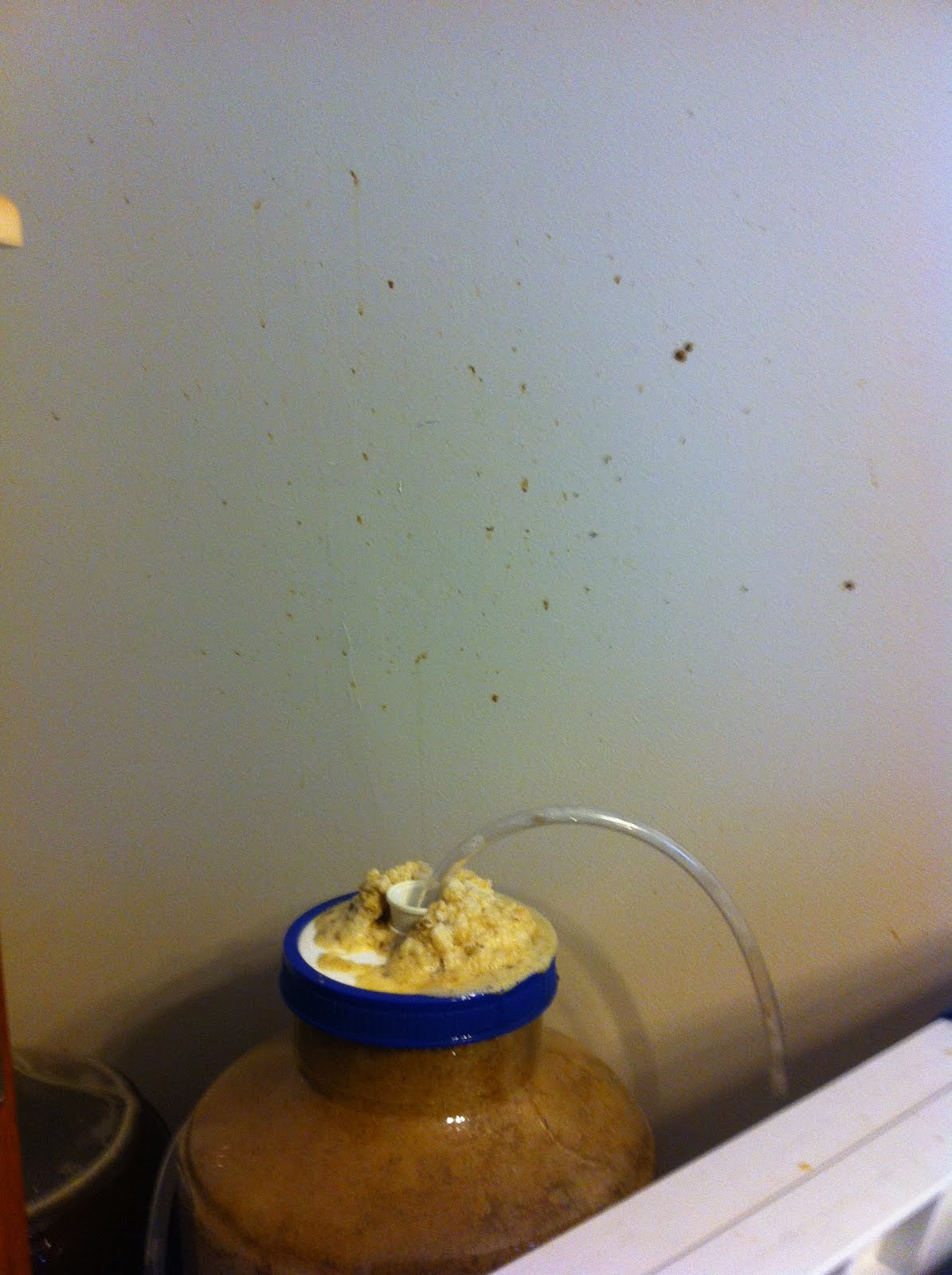
Since my fermenter was clear now, I could see the activity, so that was fun.  On 6/22 at 5:30 AM the krausen was up to the 6 gallon mark, airlock bubbling faster than once per second.  I left for a bike ride. At around 11:00 AM, i got the now infamous "I hate you. I hate your beer." phone call (sorry Lauren). Apparently the krausen plugged up the 3-piece airlock and shot it and the bung up to the ceiling, spraying foam all over.  Since I was unreachable at the time, Lauren researched how to make a blow-off tube.  We used the siphon/bottling tube shoved into a clean/sanitized bung on one end, with the other end in a wine bottle half filled with sanitizer solution.

Look at the spatter on the wall.  Just after I shot this picture and cleaned the mess off the top, it shot the bung out again.  Now the bung goes ALL the way in. On 6/27 racked to 5 gallon glass carboy and measured gravity of 1.018.

6/27-7/14/2014 - Secondary Fermentation:
7/6 dry hopped with 3 oz citra pellets added directly into the carboy.

7/14/2014 - Bottling:
I prepped my bottles the same way I did for the first 2 (if it aint broke...), hand washing 54 bottles in oxyclean and sanitizing in the dishwasher (no soap).  On bottling day, I sanitized everything else that might touch the beer with star san in the bottling bucket and let it dry completely on a clean towel on the kitchen counter.  I boiled the whole 5oz package of corn sugar in 1 c of water, cooled that in a mini ice bath, and added that to the bottling bucket.  I siphoned the beer on top of that to mix.  I think this is where I started "filtering" - I put a sanitized nylon mesh bag over the discharge end of the hose to try to catch any big chunks of the dry hop. We decided it smelled like cat pee. I didn't note final gravity, so we'll call it 1.018 from when I measured it previously, which I calculated to mean 5.8% abv. After the gravity reading, I pulled all of the bottles out of the dishwasher and we filled and capped as usual. Yield was 44 12oz bottles and 2 22oz bottles.

??? - First Taste:
I got nothing. No date, no notes.  I know it smelled less like cat pee once we drank it, and I was pretty happy with how this came out.

Brew #2: Bailee's Witbier, June 13, 2014

Brew #2 was a Witbier extract kit from my local homebrew shop, Bailee's Homebrew.  If you're in the York, PA area, you should check them out. Again, I tried to brew this as precisely to the recipe as possible, figuring I certainly did not know enough to start messing with a recipe.  Bailee's instructions were concise but clear.  What I'm not crazy about is that they don't list what is in the specialty grains. This makes it more difficult to learn how you produced the flavors of the finished product and use that knowledge to apply that to future brews.

Recipe
Batch Size: 5 gal
Boil Size: 3 gal
Target OG: 1.044-1.050
Target FG: 1.010-1.016
Style: Witbier
Recipe Type: Extract with specialty grains
Boil Time: 60 minutes

Water:
Acadia bottled spring water

Specialty Grains:
??? A mystery - Bailee's doesn't share what is in their specialty grain bags.

Fermentables:
3.3 lbs Wheat LME
3 lbs Wheat DME

Hops:
1oz Liberty (pellets) @ 60 min.
1oz Tettnang (pellets) @ 10 min.

Other:
Spice Pack (again, contents are a mystery but it involved bitter orange peels) @ 15 min.

Yeast:
Safbrew WB-06 dry yeast.  My notes are bad, so I don't know if I re-hydrated or not.

Brewing Notes
6/13/2014 - Brew Day:
  • Sanitized (star san) my cold side equipment in the fermenting bucket.  Equipment was the same as Brew #1: Auto siphon, tubing, 1pc airlock, bucket lid, and hydrometer.  I set these on a clean dish towel on the counter to dry during the brew
  • Heated 3 gal water to 150-160 F in 5 gallon economy stainless kettle on the stovetop.
  • Added mystery specialty grains in a muslin bag when the water temperature reached 110F and allowed the temperature to rise the rest of the way to 150-160F.  I held the temperature here for an additional 25 minutes before removing the bag.
  • Removed the grain bag and held it above the kettle to drain.  When I got bored of that, I set them in a cereal bowl, which I periodically dumped into the kettle during the boil.
  • Brought to boil
  • Removed kettle from the burner. On my electric stovetop, this means pick it up and move it off the burner.
  • Added 3.3 lbs wheat DME and 3 lbs wheat LME and stirred well
  • Return the kettle to the burner and bring back to boil
  • Set timer for 60 minutes and added hops and mystery spice pack per the recipe schedule
  • At 0 minutes, moved the kettle to the ice bath in my sink to chill.  This time I had planned ahead and collected some extra ice from my ice maker.  Chilled to 72F.  Ice baths take a long time.
  • Took an OG reading of 1.050, corrected to 1.052
  • Presumably pitched yeast, though I never wrote that down, and installed the lid and airlock.
  • Put the bucket in my now dedicated beer corner of the dining room
6/13 - 6/21/2014 - Primary Fermentation:
Saw airlock activity on 6/14 and 6/15, but by 6/16 the levels in the airlock had equalized.  I left this alone until 6/19 when I attempted to "rouse" the yeast by swirling the bucket around.  The airlock bubbled once every 30 seconds for a little while and then quit again.  I suspect this bucket just didn't seal well at all because this was the same thing I saw on Brew #1. Racked to 5 gal glass carboy on 6/21 because I didn't trust that the bucket seal was keeping the atmosphere out.  Measured gravity of 1.013 at this time.

6/21-6/25/2014 - Secondary Fermentation:
This was a bit of a joke of a secondary fermentation (4 days?), but I wanted to get the beer out of the leaky bucket. Saw some airlock activity and little bits of foam on the top.

6/25/2014 - Bottling:
Because it worked well for my first brew, I prepped my bottles the same way, hand washing 54 bottles in oxyclean and sanitizing in the dishwasher (no soap).  On bottling day, I sanitized everything else that might touch the beer with star san in the bottling bucket and let it dry completely on a clean towel on the kitchen counter.  I boiled the whole 5oz package of corn sugar in 1 c of water, cooled that in a mini ice bath, and added that to the bottling bucket.  I siphoned the beer on top of that to mix.  Final Gravity was 1.012, which i calculated to mean 4.2% abv. After the gravity reading, I pulled all of the bottles out of the dishwasher.  I filled while Lauren capped with the wing capper.  Yield was 51 12oz bottles.

7/4/2014 - First Taste:
This time I only waited 9 days, but with the full shot of priming sugar and the rising basement temperature, this beer was carbonated. My tasting notes are extremely brief: "Tasty, less orange-y than Shock Top."  As this one aged in the bottle, the carbonation/head got out of control again.

Tuesday, March 29, 2016

Brew #1: Fuggles IPA Extract Kit, May 3, 2014

Here was my first attempt at homebrewing.  Along with an equipment starter kit, I bought this extract recipe kit from Midwest Supplies: Fuggles IPA Kit - Midwest Supplies.  I'm not sure why I chose this one - probably a combination of the price, the fact that it was an IPA, and it had a funny sounding name.  This was a pretty simple single hop English IPA.  I tried to brew this one precisely to the instructions.  I still don't know if I got it right.  The recipe that follows reflects how I interpreted the instructions at the time.

Recipe
Batch Size: 5 gal
Boil Size: 3.5 gal
Target OG: 1.042-1.046
Target FG: 1.010-1.012
Style: English IPA
Recipe Type: Extract with specialty grains
Boil Time: 90 minutes

Water:
Acadia bottled spring water

Specialty Grains:
1 lb Caravienne

Fermentables:
6 lb Gold LME

Hops:
1oz Fuggles (pellets) @ 90 min.
1oz Fuggles (pellets) @ 30 min.
1oz Fuggles (pellets) @ 5 min.

Yeast:
Munton's Dry Ale Yeast, 6gm, re-hydrated

Brewing Notes
5/3/2014 - Brew Day:

  • Sanitized (star san) my cold side equipment in the fermenting bucket: Auto siphon, tubing, 1pc airlock, bucket lid, and hydrometer.  I set these on a clean dish towel on the counter to dry during the brew
  • Heated 3.5 gal water to 155-160 F in my new 5 gallon economy stainless kettle on the stovetop.
  • Steeped specialty grains in a muslin bag for 37 minutes (?) holding the temperature between 155 and 160.
  • Removed the grain bag and held it above the kettle to drain.  When I got bored of that, I set them in a cereal bowl, which I periodically dumped into the kettle during the boil.
  • Added 6 lbs of Gold LME with the kettle off of the burner
  • Brought to boil and managed to avoid a boil-over
  • Added 1oz Fuggle hop pellets (I think I used a nylon hop bag) and set a timer for 60 minutes. This is where I got confused.  To this day, I still don't understand if the recipe included in the kit is specifying a 60 or 90 minute boil. I suspect it should have been 60 total.
  • After 60 minutes, added 1oz Fuggle hop pellets and set another timer for 30 minutes.
  • With 5 minutes remaining on this timer, added 1oz Fuggle hop pellets
  • At (electric) flame out, chilled by placing the kettle in an ice bath.  I remember this took a long time and I melted all of the ice I had in the house - I started adding lunch box cool packs to the water in the sink.  My notes say "Next time have more ice,"
  • Gave up on chilling when the temperature reached 75 F
  • Added room temperature bottled water until the kettle was almost full
  • Transferred to the fermenting bucket using the auto siphon.  I aerated the wort by siphoning as noisily as possible, holding the end of the hose near the top of the bucket and shaking it during the whole siphoning process.  This produces a lot of foam.  So far, it seems to be effective.
  • Took OG reading - 1.042 at 74 F, corrects to 1.044
  • Pitched re-hydrated yeast on top of the wort
  • Closed the bucket and installed the airlock.  I filled the airlock with vodka.  I'm not sure why.  I put the bucket in the corner of my dining room and blockaded it with a couple of cases of empty bottles to keep my son (who had just become mobile) and my dog away.
5/3 - 5/8/2014 - Primary Fermentation:
I only saw airlock activity the second day, so by day 6, I figured either it was finished fermenting or something had gone wrong.  I opened the bucket and saw that the Krausen had fallen, so I took a gravity reading - 1.016.  Figuring the bucket just wasn't sealed well, I siphoned to a 5 gallon glass carboy.

5/8-6/5/2014 - Secondary Fermentation:
Since I was so impatient during the primary fermentation, I compensated during the secondary fermentation by waiting nearly a whole month.  The airlock bubbled every 90 seconds or so this entire time.


6/5/2014 - Bottling:
This went remarkably smoothly.  I hand washed 54 bottles in oxyclean and put them in the dishwasher overnight to sanitize with the most heat I could manage (extra hot wash - no soap, sanitizing rinse, heated dry) the night before.  On bottling day, I sanitized everything else that might touch the beer with star san in the bottling bucket and let it dry completely on a clean towel on the kitchen counter.  I boiled the whole 5oz package of corn sugar in 1 c of water, cooled that in a mini ice bath, and added that to the bottling bucket.  I siphoned the beer on top of that to mix.  Final Gravity was 1.010, which i calculated to mean 4.5% abv. After the gravity reading, I pulled all of the bottles out of the dishwasher.  I filled while Lauren (my wife) capped with the wing capper.  Yield was 48 12oz bottles.

6/19/2014 - First Taste:
Yes, I waited a full 2 weeks for bottle conditioning.  My tasting notes are simple and brief: "Ready to drink; smooth, somewhat sweet like pumpkin, reasonably clear, ok head."  I have no notes after that.  I know I served some of this a month later, and I know the head got out of control.  I took me several more brews to find out why and even more to do anything about it.